

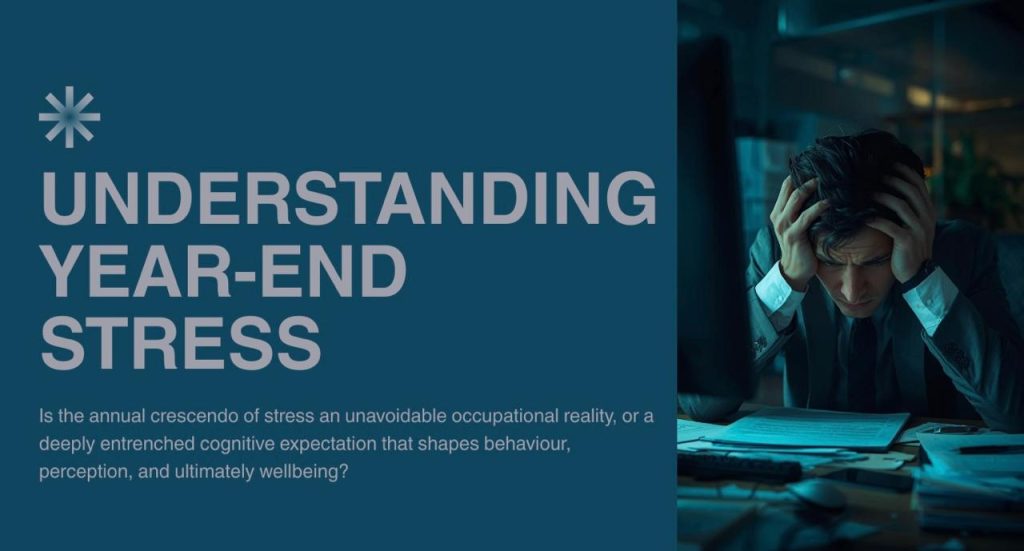
Every year, without fail, legal practitioners describe the same phenomenon: an almost gravitational pull of escalating pressure as the calendar approaches December. Matters feel heavier, deadlines feel tighter, and professional bandwidth seems to contract at precisely the moment when personal obligations expand. It is a pattern so widely reported that it has become an accepted truth of practice life: year end is chaos, brace yourself.
But is this annual crescendo of stress an unavoidable occupational reality, or a deeply entrenched cognitive expectation that shapes behaviour, perception, and ultimately wellbeing?
The Structural Drivers: Real Pressures Rooted in the Profession
There are, undeniably, concrete structural factors that elevate pressure toward the end of the year. Among them:
- Court cycles and administrative timetables
Courts, regulatory bodies, and corporate clients often push to finalise matters before recess. This creates a compression effect, with multiple deadlines clustering within a short window, often with little flexibility. - Billing pressures and financial year alignment
For many firms, year-end closes out financial reporting periods. The implicit, and sometimes explicit, expectation to achieve certain billing targets can intensify work volume and emotional load. - Professional identity intertwined with output
Legal practice is a performance profession. Many practitioners, conditioned through years of training and apprenticeship, equate year end productivity with professional worth. The desire to finish strong becomes a personal obligation rather than an organisational requirement.
These drivers are not imagined. They are built into the architecture of legal work.
The Cognitive Overlay: Stress Amplified by Expectation
Yet the psychological dimension, the beliefs, assumptions, and cognitive habits that legal professionals carry, often magnifies these external pressures. Here the question becomes more complex. Is year-end stress inevitable, or is it also learned?
Research across high pressure professions shows that anticipatory stress can be as physiologically impactful as the actual workload. The legal profession, conditioned to expect year end strain, often enters a heightened vigilance state long before true demand peaks.
Several cognitive tendencies common among practitioners contribute to this pattern:
- Catastrophising and overgeneralisation
The belief that year end is always overwhelming can lead to broad and persistent anxiety, even in years where workloads are manageable. This thought pattern acts as a self-fulfilling prophecy, colouring perception and reducing resilience. - Hyper responsibility and identity-based pressure
Legal practitioners often internalise perfectionism and personal accountability for outcomes. This heightens emotional labour in periods perceived as high stakes. - Attentional bias toward threat
Decades of training to scan for risk predispose practitioners to focus on what might go wrong during year end, amplifying stress signals while muting cues of stability.
In this way, year-end becomes not just a workflow issue but a cognitive one, a blend of legitimate demand and internalised narrative.
The Accumulated Effect: When Stress Becomes Embodied
By November, many legal practitioners have endured ten or eleven months of sustained cognitive load. Without structured resilience interventions, particularly those targeting attentional regulation, thinking habits, and cognitive recovery, pressure accumulates quietly. By year end the nervous system is already dysregulated, which makes even moderate stressors feel disproportionately heavy.
In essence, year-end stress is both real and constructed. It is real because the load exists and constructed because the mind arrives pre exhausted and primed for overwhelm.
Reframing the Cycle: Towards Evidence Based Resilience in Practice
Breaking this annual pattern is possible, not through generic wellness advice or superficial time management tools, but through cognitive training tailored to legal work. Training that strengthens mental flexibility, improves attentional control, and disrupts unhelpful thinking patterns that intensify stress cycles.
Several interventions have demonstrated meaningful impact in legal settings:
- Micro recovery practices that recalibrate the nervous system during the workday, reducing cumulative cognitive fatigue.
- Cognitive reframing techniques that challenge anticipatory stress and interrupt automatic thoughts tied to year end.
- Workload mapping strategies that help practitioners distinguish real deadlines from internalised expectations of productivity morality.
- Resilience audits that identify individual and team stress drivers earlier in the year, preventing the buildup that culminates in December.
These approaches shift the focus from managing crisis to strengthening capacity, moving practitioners from survival mode to sustainable performance.
A Closing Reflection: Rewriting the Year-End Narrative
The legal profession’s year end pressure is not a myth. It is a convergence of systemic demand, cultural norms, and long-standing cognitive habits. Yet it is not immovable. With targeted resilience building strategies, practitioners can enter December with greater clarity and emotional steadiness, and with a far more sustainable sense of control.
The real question is no longer, Why is year-end so stressful?
It is, What might the profession look like if legal practitioners entered the final months of the year cognitively equipped, emotionally regulated, and mentally resilient?
The answer is a legal culture where wellbeing is no longer seasonal, and where excellence is sustainable.
For more insights or to explore resilience solutions for legal teams, visit www.pmri.co.za.