Diffusion of Responsibility in Legal Teams: When Everyone Is Responsible, No One Is Accountable Shared oversight can quietly slow execution and increase cognitive overload Collaboration is a strength in legal practice. Complex matters often require multiple perspectives, careful review, and shared expertise. Yet when responsibility is shared without clear accountability, decision-making slows and hesitation increases. […]
Category Archives: Productivity for Legal Professionals

Productivity in legal work is not a function of speed. It is a function of cognitive clarity, structured prioritisation, and disciplined execution under sustained pressure.
Legal productivity is shaped by the realities of modern legal environments: high cognitive load, compressed timelines, constant informational inflow, and complex stakeholder demands. In these conditions, productivity declines not because of insufficient effort, but because of decision fatigue, fragmented attention, and poorly designed workflow structures.
This category examines productivity as both a cognitive and organisational discipline. Topics include cognitive load management, prioritisation under uncertainty, execution psychology, interruption control, decision thresholds, workflow design, and the hidden cost of reactive work patterns.
Rather than offering generic time-management advice, the material in this section focuses on neuroscience-informed and profession-specific strategies purpose-built for legal professionals operating in private practice, corporate legal departments, and compliance environments.
Because in law, sustainable productivity is a function of cognitive strength, structural clarity, and intelligent performance under pressure.
Why Delegation in Law Firms is Imperative to Protect Cognitive Bandwidth and Reducing Bottlenecks Delegation is not about sharing work. It is about protecting judgment. Delegation in law firms is often framed as a matter of efficiency or workload distribution. In reality, delegation is a cognitive strategy. When delegation is unclear or poorly designed, firms […]
How to Stop Invisible Backlogs by Setting Completion Standards in Law Firms: When “done” is unclear, work circulates, rework expands, and cognitive load rises Many law firms are not overwhelmed by volume alone. They are overwhelmed by the volume of work that is not cleanly finalised. Drafts are “almost ready”. Emails are “pending”. Reviews are […]
Why Everything Feels Urgent When Ownership in Legal Teams are Unclear Urgency is often a symptom of structural ambiguity, not a true reflection of priority Many legal professionals describe the same daily experience. Everything feels urgent. Emails arrive marked “ASAP”. Clients expect immediate answers. Internal queries pile up. Drafts bounce between people. Tasks restart repeatedly. […]
Why Law Firms Exhaust Their Best People First The hidden cost of decision bottlenecks in legal practice In many law firms, the most capable lawyers are also the most exhausted. This is not simply a consequence of talent, ambition, or workload. It is often the predictable result of how decision authority, approval pathways, and accountability […]
Procrastination in Legal Practice: A Cognitive and Organisational Risk, not a Personal Failing Procrastination in legal practice is often discussed as a matter of poor discipline or ineffective time management. In practice, however, procrastination in legal work is neither rare nor random. It is a well-documented behavioural response to cognitive load, perfectionism, and the structural […]
7 Productivity Principles of Successful Lawyers Successful lawyers are rarely the most frantic or the most reactive. More often, they are the ones who understand how to protect cognitive capacity in a profession that places relentless demands on attention, judgment, and decision-making. Productivity at this level is not about intensity or discipline. It is about […]
Decision Fatigue: when every decision feels overwhelming Legal professionals are required to make decisions continuously. Some are complex and strategic. Many appear small and routine. Taken together, they place sustained demand on the cognitive systems responsible for judgment, prioritisation, and self-regulation. During high-pressure periods, practitioners often report a subtle but consistent experience: decisions take longer, […]
What neuroscience reveals about why goals fail in high-pressure legal work Legal professionals are trained to plan strategically, assess risk, and anticipate outcomes. Yet when it comes to their own professional direction, many rely on intention rather than design. Statements such as “I want to be more focused this year” or “I intend to manage […]
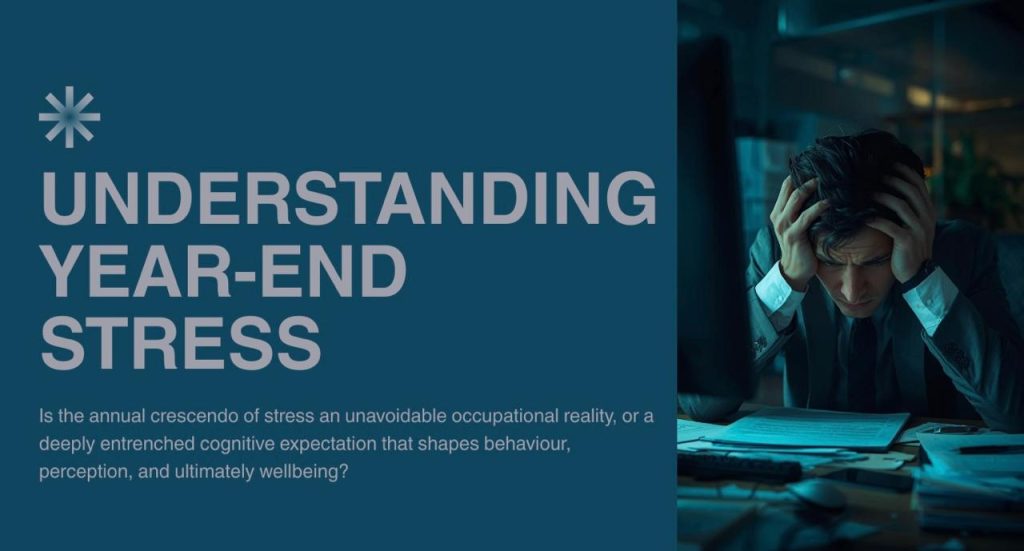
Every year, without fail, legal practitioners describe the same phenomenon: an almost gravitational pull of escalating pressure as the calendar approaches December. Matters feel heavier, deadlines feel tighter, and professional bandwidth seems to contract at precisely the moment when personal obligations expand. It is a pattern so widely reported that it has become an accepted […]